Email verification
Separate syntax, domain, mailbox, provider, and historical evidence—then define what each status should do.
Explore verification →Independent field guides for email verification, mailbox validation, deliverability, authentication, list hygiene, and risk-aware workflow design.
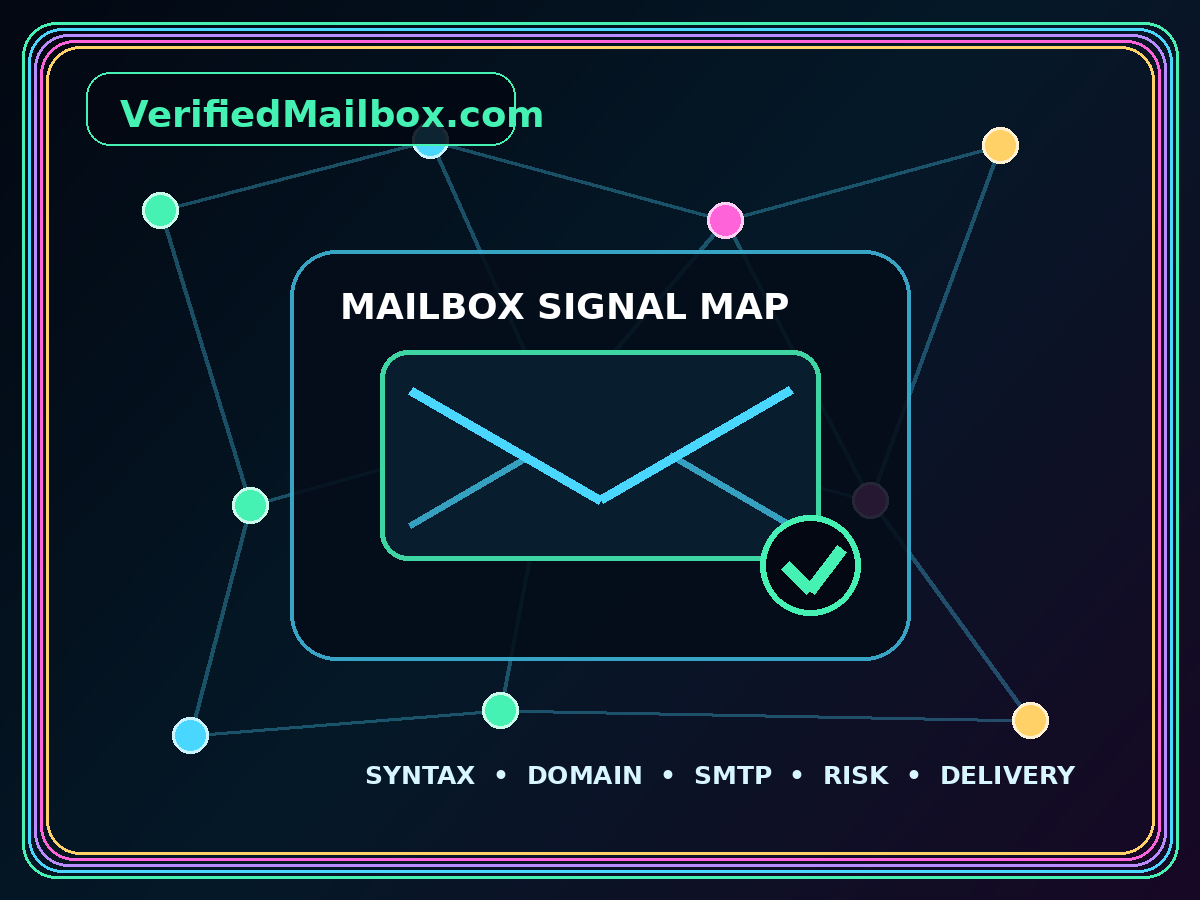
A trustworthy result keeps each layer visible. A favorable signal at one stage does not erase uncertainty at another.
Use the guides independently or follow them from address capture through sending operations.
Separate syntax, domain, mailbox, provider, and historical evidence—then define what each status should do.
Explore verification →Understand recipient responses, temporary conditions, catch-all domains, and why unknown is a valid outcome.
Map mailbox evidence →Connect address quality with sender identity, reputation, volume, content, engagement, and receiver policy.
Trace delivery factors →See how SPF, DKIM, and DMARC establish domain-level evidence and why alignment matters.
Review authentication →Design synchronous and asynchronous results, structured reasons, privacy boundaries, and safe retries.
Design the contract →Use disposable, role, age, and behavior signals proportionately without turning uncertainty into accusation.
Use safer signals →A single “valid” flag hides operationally important differences. Preserve the result family, reason, method, and observation time.
Every article includes a defined scope, practical workflow, limitations, and one authoritative editorial reference.
Use email-derived signals in fraud controls without treating mailbox type, domain age, or verification uncertainty as proof of malicious intent.
Read the field note →
Design an email verification API that is fast at capture, explicit about uncertainty, privacy-conscious, and resilient to remote mail-server behavior.
Read the field note →
A valid mailbox is only the first gate. Learn how identity, reputation, volume, content, engagement, and receiver policy shape delivery.
Read the field note →No. VerifiedMailbox.com is a static educational resource. It explains verification methods, result models, deliverability, authentication, list hygiene, and API design, but it does not submit addresses to a live verification service.
No. Verification can assess syntax, domain routing, mailbox signals, and risk context. Inbox placement also depends on sender authentication, reputation, volume, content, recipient preferences, and receiving-provider policy.
Unknown means the available checks did not establish a reliable mailbox verdict. Timeouts, temporary failures, policy blocks, catch-all routing, and anti-enumeration controls should not be mislabeled as invalid.
No. Temporary mail can be used for abuse, but privacy relays and aliases also have legitimate uses. Treat the provider category as one signal and choose a response that matches the specific risk.
Use confirmation when current control of the address matters, such as account creation, recovery, address changes, or sensitive notifications. Confirmation does not establish legal identity or permanent access.
Send corrections, source notes, or partnership inquiries by email. There is no contact form and no address-submission workflow on this static site.